Design of an Artist in Residence Studio for the
Australian Experimental Art Foundation - AEAF.
Adelaide, Australia, 2010
floor area: 52m2
volume: 249m3
budget: 200.000 AUD
Scenario
1 - Identifying roof-top airconditioning plants
as a local typology.
2 - Using their formal appearance to justify a similar, yet inhabitable, roof-top furniture.
3 - Anticipated surgery so as to transform an airconditioning unit into a studio space.
This proposal for an combined visiting artist studio and residence upon the rooftop of an existing facility takes as its starting point the often overlooked but extremely pervasive air-conditioning unit installed on top of rooftops throughout the city. Exploiting the schism between content and form, the proposal is both familiar - by taking on the formal appearance a air-conditioning unit - yet uncanny -through its parasitic relationship to its primary host the AEAF. This formal and visual ambiguity- at once familiar yet strangely alternate- parallels through its appearance the visiting artist(s) residential relationship to the city - being at once of the city yet at the same time entirely distinct from it.
Second, the proposal aims to be catalytic transforming the existing facilities both programmatically and formally, whilst having a dynamic relationship with the context. Swerving away from both representational and formal models endemic within the discipline, the proposal takes on a performative role within the city as it aims to multiply meanings as each artists' shifting relationship to the residency alters between blind indifference to fully appropriating the architectural object.
Through both extending and enlarging both the scope and ambitions of the AEAF Artist Studio + Residence brief, the proposal aims to provide something at once both surprising through its subversion of given expectations (i.e. a residency) and supplementary to both institution and observer - James Curry.
![[:en]view from Hindley St.[:de]Blick von Hindley St.](https://bette.at/bette_at/wp-content/uploads/2013/04/AEAF_1.jpg "AEAF_1") view from Hindley St.
view from Hindley St. elevations
 - plan + sections
- axonometry
- view from Register St.
Competition: Thalia NEU, Graz, Austria, 1. Prize
Collaboration with Sam/Ott-Reinisch
use: fitness centre & offices
floor area: 3600m2 volume: 16.000m3
Client: acoton
local architect: DI Strohecker
"Thalia New" is the result of an architectural design competition for a fitness studio plus offices, with the aim to restructure the existing building complex opposite the State Opera house, which, after only partial implementation of previous projects, had been left in an inhomogeneous state. The design is based on the premise that all existing roofs and facades, with the exception of those that are heritage listed, will be regarded as the site. Hence the building mass is distributed equally along and above four existing buildings, and nestles into all available niches. This allowed the perceived cubic volume to be kept low, and relevant lines of sight to be maintained. The existing heterogeneous agglomeration is ingrained and bracketed by the new volume, which also transfers the a solitary stage tower into a comprehensible spatial development. Through the inclination of the façade the urban space of the Girardigasse maintains its vertical openness. Despite functioning as an infill, the building presents itself as an independent body, with a character distinct from its surroundings. A uniform outer skin that is marked by irregular stripes of glazing, which do not differentiating between facade, roof and soffit, and an articulated spatial distance to the existing buildings, emphasizes the corporeality of the new volume. All space-forming structures are designed as a lightweight steelframe structure, functioning as storey-high trusses. The load transfer occurs through existing shear walls, which were reinforced or substituted where necessary. The entire building envelope is conceived as a foil-roof on a trapezoidal sheet metal substrate and covered by a vented skin of perforated aluminium sheets.
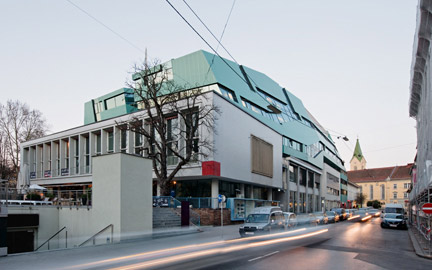 photo: Herta Hurnaus
- photo: Herta Hurnaus
- photo: Herta Hurnaus
- photo: Herta Hurnaus
- photo: Herta Hurnaus
- photo: Herta Hurnaus
- building
- model 1:100 - building and context
- interior level 5
- elevations
- elevations & plan level 6
- photo: Herta Hurnaus
Project: Adelaide Riverbank Pedestrian Bridge
Bridge Area: 3500 m2
Landscaping Area: 10000 m2
Budget: 40M $
Client: NA
The proposal combines the activation of the water edge with direct transit from the upper level of the festival plaza to the new Oval. It extends the existing landscape, creating a topography that can be used as a programmable space, e.g. allowing the functions which are currently held beneath the festival centre to extend onto the bridge.
.
![[:en]view north. image: D. Kerbler](https://bette.at/bette_at/wp-content/uploads/2012/03/AFB_1.jpg "AFB_1") view north. image: D. Kerbler
view north. image: D. Kerbler- concept
- model of bridge and landings
- view towards the new oval
- view towards the new oval. image: D. Kerbler
Invited Competition: WIFI - St.Pölten, Austria, 2.Stage
Collaboration with Sam/Ott-Reinisch, Vienna
use: trade school
floor area: 8000m2
volume: 55000m3
Client: WIFI-Technikzentrum & New Design University
Structure: Kraftfluss: Dipl-Ing. D.Gausterer, Austria
![[:en]South East[:de]Süd Ost](https://bette.at/bette_at/wp-content/uploads/2012/03/WIFI_1.jpg "WIFI_1") South East
South East- elevations West & South
- sections
- plan level 3
- North West
Unreasonable topographies
She launches 6 paradises into the orbit. He catches them one by one. The whale is always in place but never finished.
Project for the exhibition: TO THE ISLANDS
SASA Gallery, Adelaide
Curators: J. Harvey & S. Pickersgill
collaboration with Margit Brünner
![[:en]topography 1](https://bette.at/bette_at/wp-content/uploads/2012/03/2-creature.jpg "2 creature") topography 1
topography 1- topography 5
- topography 3
- whale
- whale
- dissection 1
- dissection 2
Expo 2010 - Austrian Pavillion, Competition Entry
The Pavillion works as a soundbox for 63 Instruments collected from all over Austria. The visitor interacts / plays the instruments and thus releases information and sound into the space.
in collaboration with Irene Ott-Reinisch.
renders: Kerbler & Schafschetzy
![[:en]elevation [:de]Ansicht](https://bette.at/bette_at/wp-content/uploads/2012/01/E5.jpg "E5") elevation
elevation - concept sketch
- floating network
- floating network
- interior
Project: Uralla Court II
Site Area: 1511 m2
Gross Floor Area: 120 m2
Volume: 512 m3
Client: private
Structural Engineering: Dr. Oliver Englhardt
Vienna, Austria
Residential building in Adelaide, Australia.
UC-2 is the redesign of the project 'Uralla Court' with changed parameters; the reduction of the usable space by 2/3. The spatial concept remains the same, previously enclosed spaces at the lower level are now used as sheltered outdoor spaces.
![[:en]North East[:de]Entwurfsmodell 1:100](https://bette.at/bette_at/wp-content/uploads/2012/01/UC2_21.jpg "UC2_2") North East
North East- X-ray axonometry
- south-east - image: Kerbler
- south-west - image: Kerbler
- Structural design
- Cross-Section
AN-house
site area: 170m2
gross floor area: 330m2
volume: 2100m3
client: private
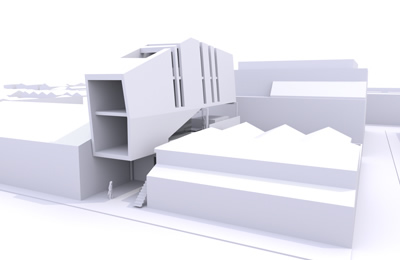
transition of an existing metal-workshop
into a residence and studio.
- Brunswick, c: google maps
- existing structure
- sketch model - concept
- sketch model - concept
- section
Project: The dragon in the sea
Island area: 12m2
Gross floor area: 50-150m2
Volume: 3200m3
Client: Government of Japan
Structural Engineering: Bollinger + Grohmann
The eroding island Okinotori-shima is situated in Japan’s southernmost territory, in the South Pacific Ocean. At high-tide two rocks, three and five meters wide, are all that remains of the island. Without these rocks the Japanese territory would end with Iwo-Jima and the country would loose 400 000 km2 of its territorial waters and, thus, the rights to fish and minerals located there. Each typhoon dimishes the rocks’ protruding surface area, which is why the Japanese government is willing to spend 250 million Dollars to protect the island. It’s crucial that no part of the supporting structure touches the island, as that would render it an artificial island with no rights to an exclusive economic zone.
The dragon in the sea is the choreography of an annual ritual. Orientated on its volcanic origin, rock material from its interior is smelted onto its peak to replace the loss from erosion. This will save the island from legal issues of territoriality for approximately 600 years. A scientist, a machinist and a registrar travel to Okinotori-shima by ship. They survey the island, calculate last year’s erosion loss, excavate rock material, smelter and deposit it on the peak of the island. The symbolic act that follows constitutes the “inhabitation” of the island. They fish, trade the catch among themselves, cook and have dinner together. Everything needed is stored inside the rock. Power and air are provided by their ship anchored besides the atoll. The island is entered through an airlock 3m below sea level. Above sea level nothing indicates the existence of the machinery and equipment.
![[:en]Okinotori-shima 20°25' N 136°05' E [:de]Okinotori-shima 20°25' N 136°05' E](https://bette.at/bette_at/wp-content/uploads/2012/01/drache12.jpg "drache12") Okinotori-shima 20°25' N 136°05' E
Okinotori-shima 20°25' N 136°05' E - EEZ: exclusive economic zone
- rock in sediment
- rock in sediment
- United Nations Convention on the Law of the Sea
- transfusion of authentic material
- embedded in an anual ritual
- formation
- section 1:50
- section + plan 1:50
Project: Amevor hause & hotel, Ho, Ghana
Site Area: 5000 m2
Gross Floor Area: 950 m2
Volume: m3
Client: F & E Amevor
Structural Engineering: Prof.K.Bollinger, Vienna
with Hannes Stiefel and Andreas Haase
![[:en]sketch model [:de]Konzept Modell](https://bette.at/bette_at/wp-content/uploads/2012/01/ghana_1.gif "ghana_1") sketch model
sketch model - sketch model
- model 1:200
- model 1:100
- model 1:50
- plan level 3